ℂ-Space Engine
A 2D physics simulation exploring mathematically consistent extensions of classical mechanics into the complex plane. This project investigates what happens when mass, position, and friction become complex numbers, without asserting physical realism.
Modified Physics Laws
I. Complex Inertia
Standard physics assumes mass is a Real scalar. In C-Space, mass allows for imaginary components.
Result: Forces and accelerations can become perpendicular due to the imaginary mass component.
II. Chiral Friction
Friction coefficients introduce a rotational drag component.
Result: Particles spiral indefinitely rather than coming to rest.
III. Conjugate Gravity
The inverse-square law extended to the complex plane.
Simulation Results
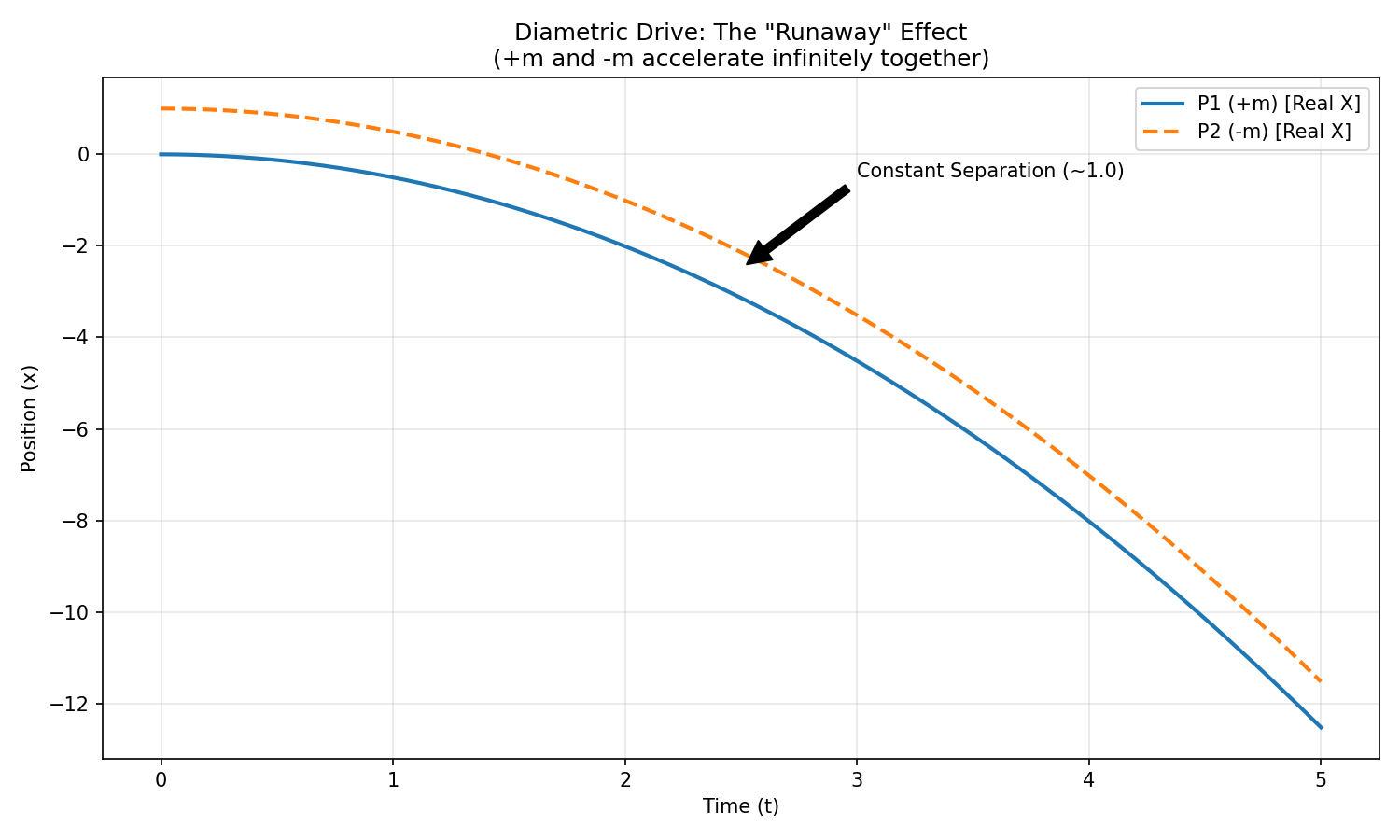
Negative Mass Runaway
Testing the interaction between positive mass () and negative mass (). Since repels while attracts , both particles accelerate in the same direction. This concept is theoretically possible in General Relativity but realized here in the C-Space engine.
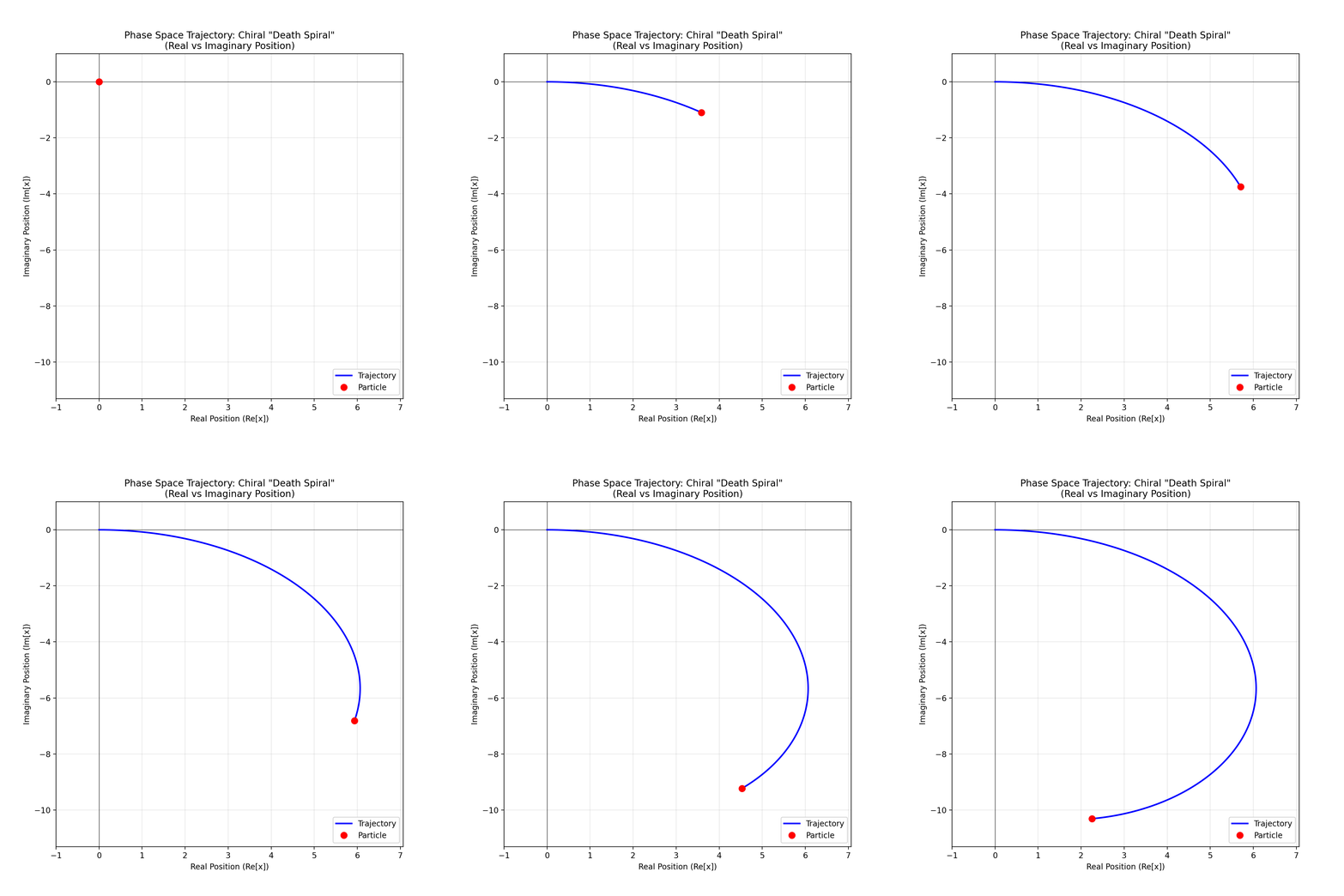
Chiral Friction Decay
Demonstrating the Chiral Friction Law. A particle with initial real velocity experiences complex drag (). The imaginary friction component applies rotational force, causing the particle to spiral rather than stopping.
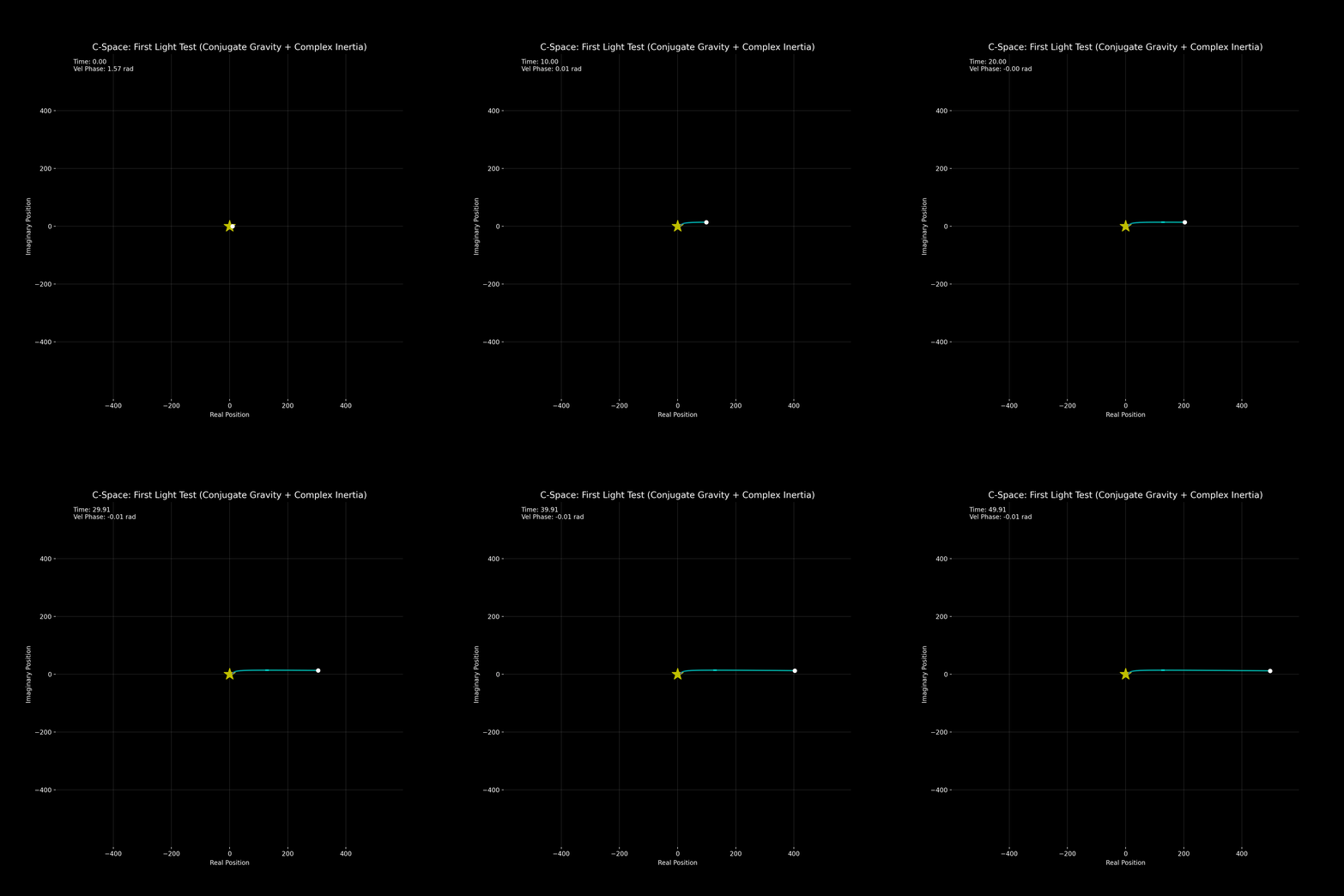
Complex Orbital Motion
Testing gravitational orbits with complex gravity () and imaginary inertia. The planet traces a precessing trajectory that never forms a closed ellipse, eventually decaying due to Chiral Friction.
Simulation Axioms
Fundamental Constants
- Space (Complex Plane)
- Time (Real Stream)
- Gravity (G)
First Light Config
- Sun Mass (Fixed)
- Planet Mass (Inertial)
- Friction (k) (Chiral)
Engine Architecture
- Custom C++20 Kernel: Manual implementation of complex vector arithmetic and RK4 integration.
- 4D Phase Space: Native support for collision detection (overlapping in Real dimensions doesn't guarantee collision if Imaginary depth differs).
- Analysis Pipeline: CSV export to Python/Matplotlib for phase portrait generation.
References
[1] Forward, R. L. (1990). "Negative matter propulsion." Journal of Propulsion and Power, 6(1), 28-37.
[2] Bondi, H. (1957). "Negative mass in general relativity." Reviews of Modern Physics, 29(3), 423-428.
[3] Ablowitz, M. J., & Fokas, A. S. (2003). Complex Variables: Introduction and Applications. Cambridge University Press.
[4] Needham, T. (1997). Visual Complex Analysis. Oxford University Press.
[5] Hairer, E., Lubich, C., & Wanner, G. (2006). Geometric Numerical Integration: Structure-Preserving Algorithms for Ordinary Differential Equations. Springer.